ENGINEERING NOTES / PENTESTER
Pentester: AI-assisted penetration testing for web apps and APIs
Pentester is CloudGuys' AI-assisted penetration testing service for B2B software teams. See what it covers, what you receive, how a retest proves a fix, and how a fixed quote works.

Pentester is CloudGuys’ AI-assisted penetration testing service for web applications and APIs. We agree a scope with you in writing, assess it on an AI penetration-testing workbench, and hand back an executive brief, evidence-backed findings and a follow-up record. You pay a fixed quote for the agreed scope, and you install nothing.
This post is the short introduction: who it is for, what you get, and why we built the workbench to be cautious about the word “fixed”.
Who is Pentester for?
Pentester is for B2B software teams that need a security assessment for a reason with a date on it: a release, a customer security questionnaire, a new tenant model, or a recurring review. It fits a SaaS product with several user roles, a public or partner API, or a repository you want assessed alongside the running app.
If you need to hear “we tested it” to close a deal, Pentester gives you more than a pass mark. It gives you the evidence and the limits of the test.
What can Pentester assess?
| Service | What it covers |
|---|---|
| Web application assessment | Account boundaries, access roles, workflows and the paths that handle sensitive data |
| API assessment | Public, private or partner endpoints, authentication schemes and business operations |
| Source-assisted review | A scoped assessment paired with a named repository and revision, so developers can map findings to components |
| Remediation validation | A review of agreed findings after your team ships fixes |
Under the hood, the engine accepts web URLs, Git repositories, local source, single IP addresses and OpenAPI files. It can combine a repository with the running app for a white-box view: it reads the code, then tests the live application.
We do not assess live cloud accounts, clusters or registries. Pentester reads Terraform and Kubernetes files when they are part of a repository, but live cloud posture is a separate job.
What do you receive?
Every engagement produces three things:
- An executive brief that says what matters to the business, including unresolved risks and the places coverage was limited.
- Engineering findings with the affected surface, evidence, impact and recommended remediation.
- A follow-up record that shows what changed on retest and what still needs attention, when a retest is in scope.
The workbench also exports a Markdown report, JSON, and SARIF 2.1.0, so findings can flow into the code-scanning tools your engineers already use.
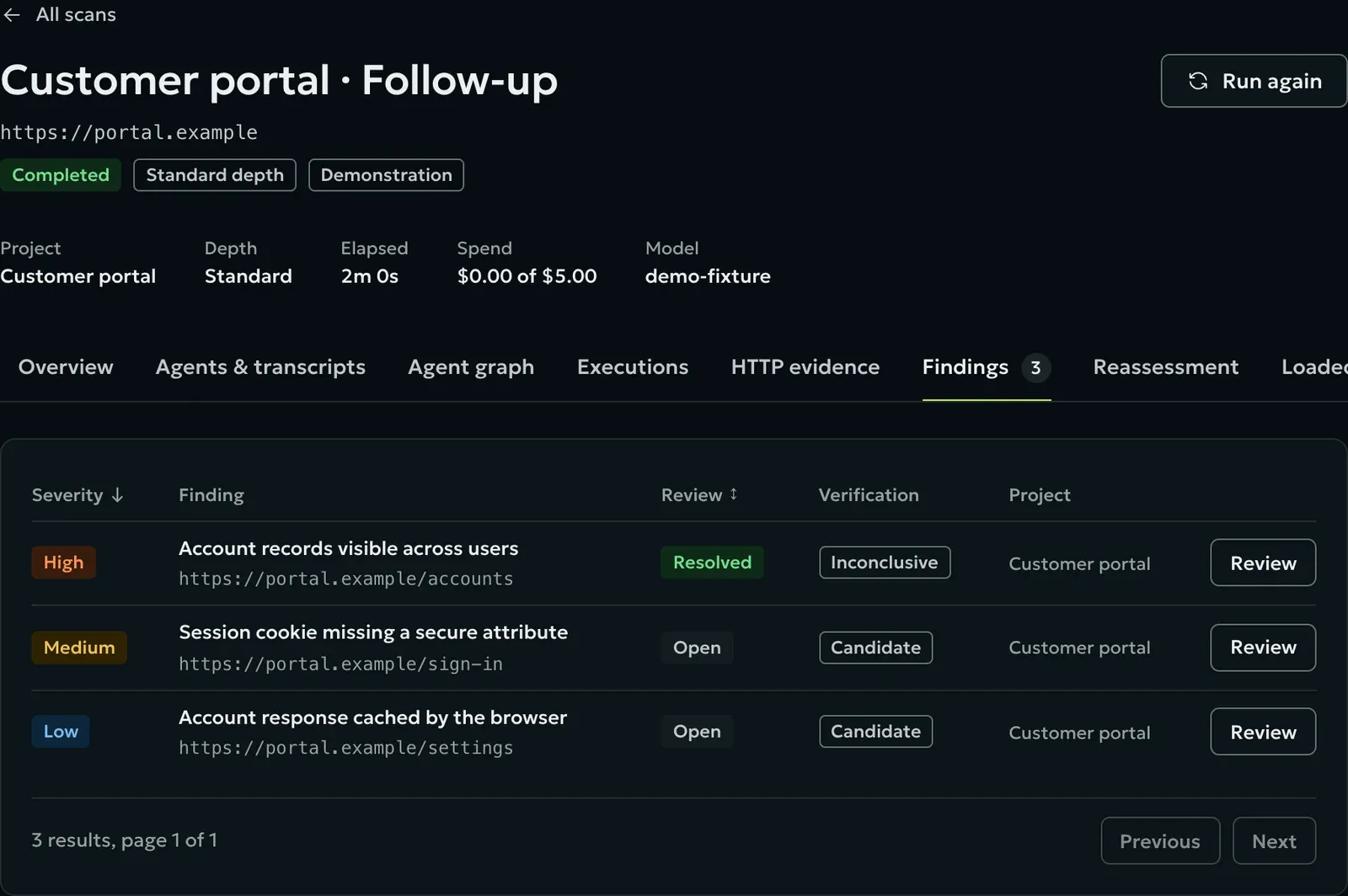
The workbench in demonstration mode, using a fictional workspace. The demo engine records sample activity; no target or model was contacted.
How does Pentester separate evidence from opinion?
Each finding carries three labels that never merge into one:
- Severity: critical, high, medium, low or info.
- Review: open, under review, resolved or accepted risk. A human reviewer sets this, with notes.
- Verification:
candidate,reproduced,verified,inconclusiveorwithdrawn. Only independent evidence sets this label. An AI agent’s claim that it verified an issue cannot set it.
That separation matters because AI-assisted testing produces plenty of plausible claims. A candidate is a lead awaiting independent evidence, not a verified vulnerability. Marking a finding “resolved” in review does not change its verification label either.
How does a retest prove a fix?
A common failure in security reporting is treating silence as success. Pentester does not.
When your team ships fixes, Run again creates a linked assessment. Old and new findings are matched by fingerprint, and each gets one outcome: new, still present, not reproduced, fixed, inconclusive or blocked.
The rule is strict: a finding that is absent on retest is “not reproduced”, never “fixed”. “Fixed” requires an independent regression check against the original technique, with a healthy target and valid test sessions. If a test account expired during the rerun, the result becomes “inconclusive” rather than a false all-clear.
How is Pentester priced?
With a fixed quote for an agreed scope. The main drivers are the number of applications and APIs, the roles and workflows to cover, source access, the testing window and how much follow-up you want. Your proposal states scope, coverage, timing, reporting and any retest. If scope changes, we agree the commercial change before adding work.
For a first quote, a short description of your product, the asset types, the rough number of access roles and your deadline is enough. Share credentials and sensitive diagrams only through the transfer process we agree in scoping.
What does Pentester do with your data?
The workbench sends no telemetry: no analytics collectors, release polling, report relays or browser beacons. Model prompts still go to the model provider configured for the assessment, and scan tools still contact the systems they test, so we agree in scoping which environments, data and providers are appropriate. We prefer staging and synthetic data where the engagement allows.
FAQ
What is Pentester? CloudGuys’ application security practice and the AI penetration-testing workbench behind it. We assess web apps, APIs and source code against a scope you authorize in writing.
Is Pentester a scanner I run myself? No. CloudGuys runs the assessment and delivers the report. You do not install anything.
Does AI replace a human reviewer? No. The AI engine does the testing work, but review status is a separate, human-owned field, and verification labels come only from independent evidence.
Can Pentester test our API? Yes. Scope the endpoints, authentication schemes and business operations in the proposal. An OpenAPI specification helps us plan coverage.
Is a retest included? Your proposal says. It states whether a retest is included, which findings it covers and when it can be scheduled.
How do we get a quote? Send a short description of your product, what you want covered and your deadline.
Talk to us about your scope
Pentester is built and operated by CloudGuys. See the Pentester product page or visit getpentester.com. For a scoped quote, email [email protected] or use the form on getpentester.com.
BUILT AND OPERATED BY CLOUDGUYS
Pentester: ai-assisted penetration testing
Security testing with a clear path to the fix, for web apps and APIs.
Scoped web application, API and source-assisted security assessments for B2B software teams, run on an AI penetration-testing workbench. Every finding carries evidence, a separate severity, review and verification label, and a retest compares the fix against the original proof. You get an executive brief, engineering findings and a follow-up record for a fixed quote.
Discuss your scope ↗ About Pentester ↗